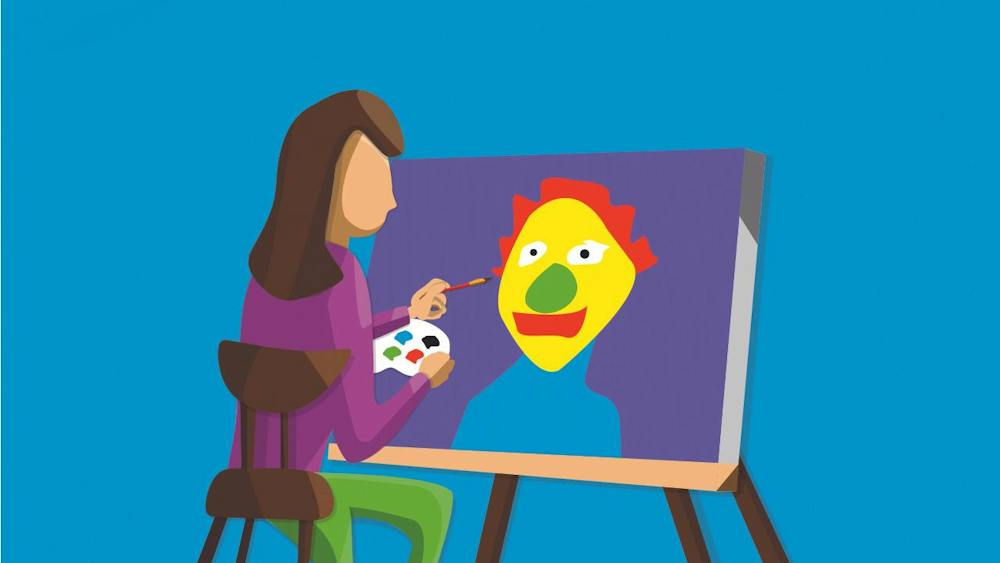
In today’s busy world, there’s a quiet resistance in carving out time for yourself and directing your attention toward a personal, creative hobby. Whether it be music, visual art, pottery, baking, crochet, writing or any other skill, you can build something real and human through sheer passion. Spiraling music notes, splashes of saturated colors, spilling selected words onto paper — everything comes together. And the end result is sometimes ... bad.
And that in itself can be beautiful.
Taylor Marie Reid, a University of South Carolina senior, began her business by selling hand-lettered art at Christmas craft markets. Reid was inspired by her mom to pursue art more professionally, and she kickstarted her business, TM Designs, in 2020.
There is a societal push to hustle and monetize hobbies, something Reid believes is often well-intentioned.
“If I create something, my parents are always quick to give me ideas for how to sell it. It was that way even as a kid,” Reed explained. “From their perspective, they’re like: ‘That’s so cool, someone could buy that.’”
This message, however well-meaning, can often perpetuate the idea that we must create technically skillful masterpieces to sell for a profit, and that joy alone isn’t a priority. This dissuades people from starting new art forms because, of course, you will at first be bad at them.
Many artists pretend that we were never in the “bad art” stage to begin with. We grow embarrassed at any mention of old works and erase any vulnerable evidence that we were once learning and developing our skills. We attempt to replicate what we consider good art. We attempt to do art the right way.
Reid explains how this perspective on less conventional art can be different for a seller and a buyer.
“I do like things that are kooky and really outside the box,” she says. “I would buy just a sketch if I thought it was genuinely cool and reflected that person’s art style. But also, at the same time, I wouldn’t sell my sketch.”
The previously mentioned goal of doing art the “right way” can quickly kill the passion for creation. We are limiting ourselves when we try to create only good art, even if it doesn’t conform to the societal norm of what art “should” be. We forget that there is importance in communicating ideas and personal perspectives, no matter the skill level.
Bad art is free from constraints. It is unique, full of personality and feels honest and alive in a way aesthetically pleasing art often doesn’t. Creating bad art is resistance against a society that values monetary gain and function above joy and passion. It’s a way to develop our personal style with curiosity rather than constraints. It’s a way to have fun again.
When asked about balancing joy with the more stressful aspects of running a business, Reid said:
“Calligraphy and art are a core part of who I am. I would almost hate for that to get intertwined with job and obligation. So, to me, having fun is much more important than being good at what I do.”
However, it is also important to acknowledge how expectations for art may be different when it comes to a future career or other business owners.
Kyra Rankin, a USC student who runs the business Dreamy Comforts, began her sewing journey in fifth grade at an after-school club. When thinking back about her beginner sewing projects, she initially recalls sewing as just a hobby.
Rankin emphasized the difference in her experience once she began to pursue art through a business perspective. She describes how when creating for others, there’s naturally more stress surrounding the outcome, and that people place higher value on projects that can be sold than on hobbies.
“I have such a big vision for my business. I don’t think it can compare to a small-time hobby,” she says. “But a hobby is important, because I need to take time and do things for me.”
Rylee Matthews, the content creation manager for the Student Made USC branch, speaks on her experience with pursuing photography professionally. Upon filling the role of a senior USC student as Student Made’s photographer, Matthews too experienced the common, internal pressure to be “good enough.”
“I didn’t want to come into this role and let the creators down, because they already could trust her," Matthew said, regarding the former photographer. "They knew her photography style. I was a completely new face, so I think it was a lot more internal pressure. But everyone around me was very encouraging, and I think that in turn motivated me to take it more as a learning lesson rather than something I should steer away from.”
Matthews emphasized that joining a creative business community to grow your skills can also be an empowering experience. For Matthews, improvement and enjoyment don’t necessarily have to be at odds.
“The benefits [of Student Made] are the hands-on experience, and you’re surrounded by so much creativity," Matthews said. "It felt like a breath of fresh air.”
Creating art for a business is an inherently different experience than a personal hobby, and it contains a unique set of benefits and constraints. Reid, Matthews and Rankin illustrate how profit does not always have to conflict with passion, and how running a business can be empowering. However, it is still important to recognize that there’s also worth in bad, hobbyist art done solely for fun. It’s freeing for anyone to have a hobby just for them, especially if they also pursue art as a business.
There is worth in solely an individual’s happiness. Wavering notes, clashing stitches, awkward anatomy, burnt pastries and uneven clay are something remarkably human. There is a person behind these creations who tried something new, and even if the result is bad or “cringe,” it is something to be admired.
The focus of creation could be on enjoying the process. The end result could be a part of the desire, but not encapsulate it. Because if there is no joy behind art, the process itself becomes bleak.
The antidote to a stressful artistic process is to create for our own happiness and curiosity rather than the anxious need to be “good enough.” We must not forget to create out of love rather than fear. Creating and celebrating bad art is inexplicably human, and is a fundamental part of that process.


