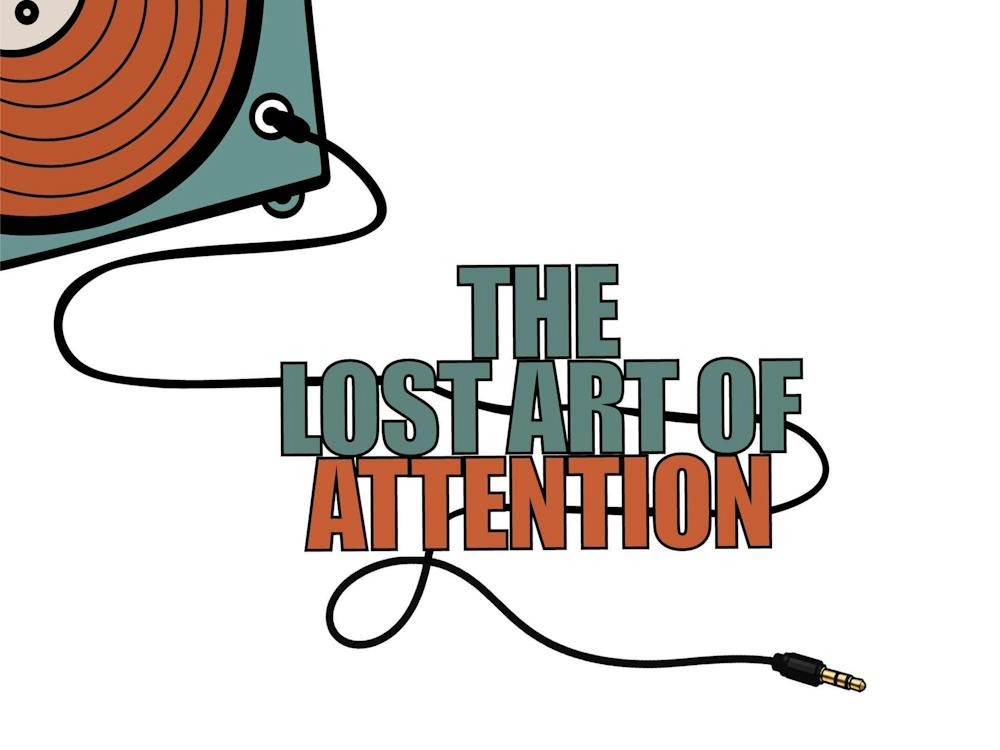
Our attention spans are getting worse, and we all know it.
Whether we find it hard to sit through class or skim through longer videos, we see this phenomenon impact our lives in different ways. In a culture that encourages rushing through our days, it’s no wonder that we long for more technology-driven shortcuts and convenient summaries.
The need for fast information and entertainment has caused a rise in short-form content, which has, in turn, trained our brains to expect instant gratification. The internet is no longer a place we choose to visit and leave. It is now an extension of ourselves. Our days are spent shortening waiting times and maximizing efficiency, which causes us to miss out on intentional, day-to-day experiences.
However, this modern lifestyle has led to an interesting counter-trend. Alongside the current rise in technology, we’re seeing a simultaneous resurgence in physical media. From people collecting DVDs and game cartridges, to those who prefer reading physical books, it's no surprise that in a world so focused on maximizing efficiency, many people prefer older technology with more friction between desire and outcome, forcing us to slow down.
Jacob Burke, a USC student who got into music because of his family, collects second-hand CDs and vinyl records. Though Burke originally started collecting CDs because his car does not have Bluetooth, he continued for a variety of other reasons.
“I started loving having so many, and supporting the artists that I listen to and who brought me to who I am today.”
With the internet at our fingertips, there is an overwhelming amount of content. There’s something more tangible and concrete about a curated collection we gather and own ourselves, rather than being fed by corporations, algorithms and ads. This is highlighted by Burke’s collection, as he now has more than 90 CDs and 40 vinyl records. Going back to tactile, physical media puts the user in control of the content they chose to own and consume.
Burke explains that a unique benefit of physical media is how the owner permanently retains the content. He details that on streaming platforms, listeners sometimes cannot access the songs they love due to copyright deals or removals. When it comes to buying vinyl records and CDs, he emphasized a key point about ownership.
“You own the actual physical media, and that can’t be taken away from you.”
Another unique experience of physical media is the search for new content. Sifting through rotating stock can be compared to a treasure hunt, as you never know what you will end up with. Persistence pays off upon finding a hidden gem, and this grants the seeker a sense of accomplishment that isn’t simply short-term gratification.
Burke details another aspect of physical media in relation to music: it is harder to physically skip songs. This means many people listen to whole albums the way artists originally intended the experience.
“I think that albums have become less comprehensive, and have become more track-by-track…many artists are just trying to create trending tracks instead of cohesive works of art.”
Because of this, we are missing out on songs we may enjoy, simply because they are not trending. Although the internet and digital technology are now ingrained in our everyday lives, physical media is a great way to take a step back. When using physical media, the content stays the same, but the form changes. This return to a slower form of consumption forces us to consider how we actually want to spend our attention.
Burke said, “I love just coming home and putting on a record while cleaning the house, or just sitting down and listening to records with my friends.”
In this way, listening to music becomes an experience and pastime. From listening to music on CDs rather than Spotify to going to stores rather than ordering online to seeing movies in theaters rather than on streaming services, we crave in-person, tactile experiences. There is value in the hurdles it takes to do tasks that would otherwise be frictionless.
“It’s almost like a ritual: putting the record on, moving the needle, dropping the needle, flipping the record," said Burke of vinyl records.
This highlights how there is something human about imperfect, slower experiences with media.
This is also why we are seeing a rise in “dumb phones,” which shifts digital phones closer to physical media. Younger generations are uninstalling social media apps, which returns these phones to their basic functions. This allows people to still participate in the activities essential to modern life, like texting, searching or calling, while minimizing the impact of other addictive apps. In this way, phones become closer to physical media, as they are only equipped to handle a few purposes. "Dumb phones" become a place to occasionally visit rather than an environment to instinctually exist within. Without apps to constantly fight for our attention, we are able to be more present in our actual lives and not spend our hours scrolling.
How we choose to use our time and energy makes us who we are. With the rise of digital technology, it’s easier than ever for us to unintentionally shift our attention away from where we intend it to be. It’s no surprise that this led to a counter-trend: the resurgence of physical media.
In an age of digital convenience, the rise of physical media is a reclamation of our time, attention spans and human experiences.


