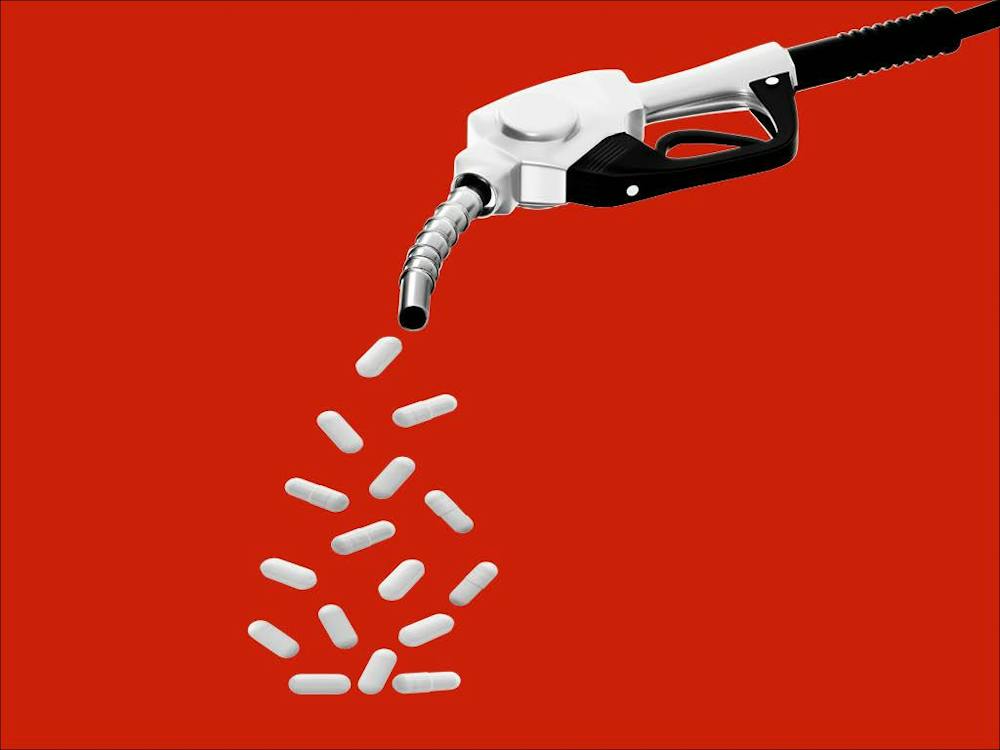
A trip to the gas station is usually pretty simple: fill up your gas tank, grab a couple of snacks and maybe a drink if you’re feeling fancy. But in many stores, another product that attracts crowds sits just behind the counter.
Commonly sold in a variety of forms, products containing kratom and 7-hydroxymitragynine (7-OH) have become increasingly accessible at gas stations and convenience stores around Columbia. Kratom is properly classified as a herbal product produced from the leaves of the Mitragyna speciosa tree native to Southeast Asia. It is commonly used within spiritual rituals, but recent spikes in usage have been tied to its abuse potential.
This is attributed to its trace concentration of 7-OH, a highly psychoactive substance that acts on opioid receptors, therefore eliciting similar effects as common opioids. When kratom is ingested, the active component of the leaf is metabolized into 7-OH in the liver, leading to the associated opioid-like effects at high doses (greater than 6 g). Current issues surrounding 7-OH are focused on synthetic products that have increased drug potency or strength, leading to an increased risk of overdose and addiction.
Despite FDA acknowledgement of the abuse potential of these two substances, there are currently no federal regulations limiting their access. In fact, a simple ten-minute walk from campus will land students in a store that can sell them these substances.
Kratom's free circulation within the nation has coined the term “gas station opioids” due to their ability to act on opioid receptors. However, the increasing availability of highly concentrated and synthetic types has raised concern in the medical community, especially when they can be purchased in normal retail environments.
Sayward Harrison, Ph.D., a health psychologist and Associate Professor in the Department of Psychology, explains the issues with its open accessibility.
“The bottom line is, right now, it's really a patchwork, and the industry is largely unregulated, and we don't have product testing or regulatory oversight over what's in these products that are being marketed and sold," Harrison said. "So individuals who are using kratom and 7-OH products right now may not know exactly what is the product they are consuming which can be really, really dangerous."
While kratom is not an opioid in itself, its activation of opioid receptors can lead to similar effects depending on dosage. According to a report by the Food and Drug Administration (FDA), low dosages (less than 6 g) lead to basic stimulant-like effects, such as increasing heart rate and alertness. On the other hand, high doses can lead to intense pain relief and relaxation, two common effects associated with basic opioids like oxycodone and morphine. In fact, the FDA attributed 7-OH to being more potent than morphine, a heavily controlled opioid with high abuse potential.
This is where the issue of marketing and not being properly informed comes into play. Many kratom/7-OH-containing products use key words like “natural” and “wellness” to appear like natural supplements to the average consumer instead of opioid equivalents.
Due to the novelty of these substances within the U.S. drug supply, many students are unaware of their true effects, framing these products as another wellness supplement that can improve their health without any adverse side effects. Moreover, drugs obtained outside of highly regulated areas like hospitals are rarely pure and usually contain a mixture of other substances that can be unknown to the buyer.
“But again, because these products that are being sold as kratom and 7-OH are not regulated, they can have very different levels of potency and different materials that are mixed into that product, so they impact the body in really unpredictable ways since you have no way of knowing what's exactly in it," Harrison explained.
As recently as July of this year, the Drug Enforcement Administration (DEA) filed a motion to temporarily place 7-OH and three closely related substances in Schedule I of the Controlled Substances Act. Schedule I is the strictest level, identifying drugs with high abuse potential and no alleged medical use. While this placement has not been implemented, there has been discussion over the consequences of this policy.
It is also important to note that this classification excludes kratom, which is still subject to no federal oversight.
Steven Harrod, Ph.D., a professor in the Department of Psychology and a researcher at the Center for School Behavioral Health, highlighted loopholes in the DEA’s motion.
“Synthetic chemists are making 7-hydroxy, and when it becomes scheduled, they will then shift to analogs," Harrod said. "That’s the standard move in the book of licit then regulated compounds."
An analog is a substance that is similar in chemical structure and pharmacological effects to a controlled substance, which is 7-OH in this case. The main difference is that the analogs are not under any regulation and can have differing potency, while the main drug might be. One specific analog of 7-OH is MGM-15, a partially synthetic compound produced from 7-OH that is actually more potent (higher abuse potential) than 7-OH.
However, there is always another side to every topic.
“There probably is utility for pure kratom – the actual, the real thing – to help people get off of either strong opioids. There are another branch of scientists who say maybe to use it to get off of Suboxone or Buprenorphine because these aren’t minor either," Harrod said.
At low doses, the FDA acknowledges kratom’s ability to wane people off more dangerous substances like fentanyl and help curb the side effects associated with opioid withdrawal. Two substances Harrod noted – Suboxone and Buprenorphine – are commonly used to treat opioid use disorder and have mild to serious side effects.
While there is not much that can be done about the current policy landscape of the U.S. drug industry, Harrison and Harrod both note the importance of increased research into these substances and for students to stay informed.
Harrison serves as Director of the Integrated Care for Recovery Center on campus, a federally funded clinical center focused on improving behavioral healthcare services for those facing substance use disorder within the state. Harrod also works in the center. Together, they help provide substance use disorder treatments to people in need, whether that is through serving as community distributors for naloxone, which is commonly known as Narcan, an opioid reversal agent, or providing training programs for psychologists.
Located in the Hamilton Building, the center hopes to emphasize the importance of drug-related research and community outreach to assist students concerned about their substance use.
"People who use drugs often experience high levels of stigma and discrimination from community members, healthcare providers, and even their own friends and family," Dr. Harrison said. "This really makes it really difficult for individuals to seek the care and support they need. So, I would want people to know that we have lots of effective treatment strategies, and especially for people with opioid use disorder, we even have really effective medications that can help a person reduce their use, and stop their use altogether. Long-term recovery is possible, but we have to get stigma out of the way so that more people are able to access it."


