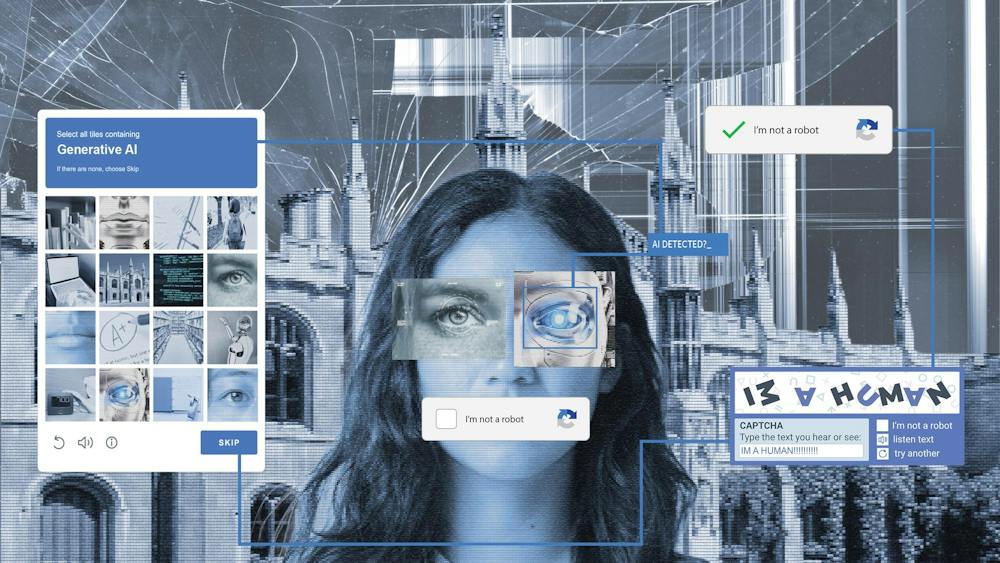
Nina*, a sophomore at USC, felt her face burn with anger and humiliation as she stood in front of her language class. Her professor was using her paper as an example of what not to do in the classroom — that is, use AI for assignments. There was only one problem: she hadn’t used AI at all.
“[My professor] was like, 'Go ahead, tell everybody here that you didn't use AI,'” Nina said. “And so, of course, because that's who I am, I stood up and looked at the whole class and said, 'Okay, I didn't use AI on this.'”
The argument between Nina and her professor was accusatory and ugly, with Nina saying she felt “offended” after the interaction. However, these kinds of situations are not just specific to one class or professor: USC’s Office of Student Conduct and Academic Integrity reported that almost one-third of all Honor Code cases reported in the 2024-25 academic year "referenced the use of artificial intelligence.” Compared to the 2023-2024 school year, AI cases increased by 100.
USC’s policy on academic integrity regarding AI use has been evolving since the emergence of ChatGPT in 2022. Although Nina’s professor did not pursue punitive action against her, those accused of using AI can be placed on conduct probation and must complete an Academic Integrity Workshop or an Artificial Intelligence Module, as reported by the university.
Nina recalls urging her professor to broach his accusation with the Office of Student Conduct and Academic Integrity and says she did not appreciate her honesty being questioned.
“I really do pride myself on my work. I work very, very, very hard, and I take a lot of pride in my education,” Nina said. “[Being accused] was disgusting and horrible.”
Nina said she was wary of AI even before she was accused of misusing it, calling its normalization “insane,” especially among her peers at the university. She believed using AI in place of genuine learning is dangerous and can lead to a decrease in critical thinking skills.
A study done by Microsoft in April 2025 suggested that if a user has a high level of confidence in the AI’s output, their critical thinking skills decrease. If users have a lower level of confidence, the opposite is true.
“I still don’t use AI because, at the root, my principles haven’t changed,” Nina said. “I want to know what I’m doing, and I need to know that I know it for the future.”
Recently, AI seems to be on the minds of professors and students alike. One such professor, Jason Porter, offers a different viewpoint on AI. He is a senior instructor in the School of Journalism and Mass Communications in the visual communication sequence. Porter launched a journalism course called "Fundamentals of Generative AI for Content Creation," and his stance on AI detection tools used in the classroom is a staunch one.
“There have been so many instances where they provide a ton of false positives,” Porter said. “And if you are using an AI detection tool to determine something like academic integrity, you've got to make sure that thing is 100%. Otherwise, that’s not fair.”
Porter says that the “guilty until proven innocent” mindset that certain universities have about AI may be too rash. These accusations can discourage students from actually learning how to use AI as a tool. Just like any tool, it can be used either correctly or incorrectly:
“If I have a hammer, it’s great that I have it, but I have to know that a hammer is for a nail, not for screwdriving. That’s literacy,” Porter said. “If I have the hammer police running around because I’m using a hammer incorrectly, why don’t you teach me how to use it instead of just telling me I’m wrong?”
Ultimately, Porter says that universities should put a focus on teaching students how to use AI in an ethical and responsible way, as opposed to scaring them off from using it entirely.
Although some believe that it is the responsibility of universities to encourage proper AI usage instead of villainizing it entirely, that may place a burden on those tasked with enforcing these standards. Anna Puente is a Ph.D. student and graduate TA for the Department of Political Science who says that AI detection tools are far from perfect. She says she exercises caution when using them to assess student work. However, Puente says that monitoring the use of AI in classrooms is difficult.
“There’s not really anything I can do about it,” Puente said. “And there’s not anything I can do about it in a way that would be fair.”
Puente says that the role of AI in the classroom is a challenging subject. This obstacle makes accusing a student of using AI contentious. When professors accuse students of using AI in inappropriate ways in the classroom, Puente views this as a bandwidth issue. Additionally, teachers may become frustrated by flagrant AI usage.
“I think most professors don’t mean to call out students too much or to falsely accuse them, but that’s part of their job,” Puente said. “They are expected to report things and that can get really difficult.”
Because AI detection tools can often be inaccurate, this puts both the university and its students at a difficult crossroads. A study done by a group of researchers from different universities found that AI detection tools often produced “false positives” — a term that describes when a detection tool misidentifies student work as AI-generated.
The study found that while some AI detection tools identified human-written text with an average accuracy of 96%, they struggled to detect AI-generated content, especially when it had been edited by a user. According to an MIT summary of the study, AI detection tools identified ChatGPT-generated text with 74% accuracy, but that figure dropped to 42% when the text was slightly edited.
While the debate about AI use in classrooms has been heavily disputed since the recent popularization of AI tools, Puente takes a more forgiving stance.
“I think students are just trying to get their work done" Puente said. "Most students, I think, are just trying to do their best. And then, I think professors are doing the same.”
As AI continues to gain prominence, but AI detection tools lag behind, how do institutions remain consistent with their values of academic integrity while also giving students a fair shot at producing authentic work?
Although Nina is not a fan of AI in her personal life, she understands the importance of continuing to evolve with the tool.
“The world is evolving. Technology is going to keep moving in the right or wrong direction, depending on how you look at it,” Nina said. “You have to find ways to keep moving with it instead of having to fight against it.”
*Name changed for anonymity.
Editor's Note: Jason Porter is on the Board of Publications, the publisher and governing body of Garnet & Black.


