The squeak of his sneakers on the indoor Olympia basketball gym filled his ears along with the distinct thump of the ball hitting the ground. The hot August sun had begun to set already. Soon, Bryson Harry was joined by two young men, and they began to play together. When Harry asked about their grade levels, he was surprised to hear that both men, although around his age, were not university students. They had been living in the Olympia Mill area for their entire lives.
“The life here is mostly students. I mean, that’s why my assumption was that way when I met those two people back in August,” Harry said. “These are people that are getting priced out of their homes by what the university and PMC deems to be what college students are being able to pay.”
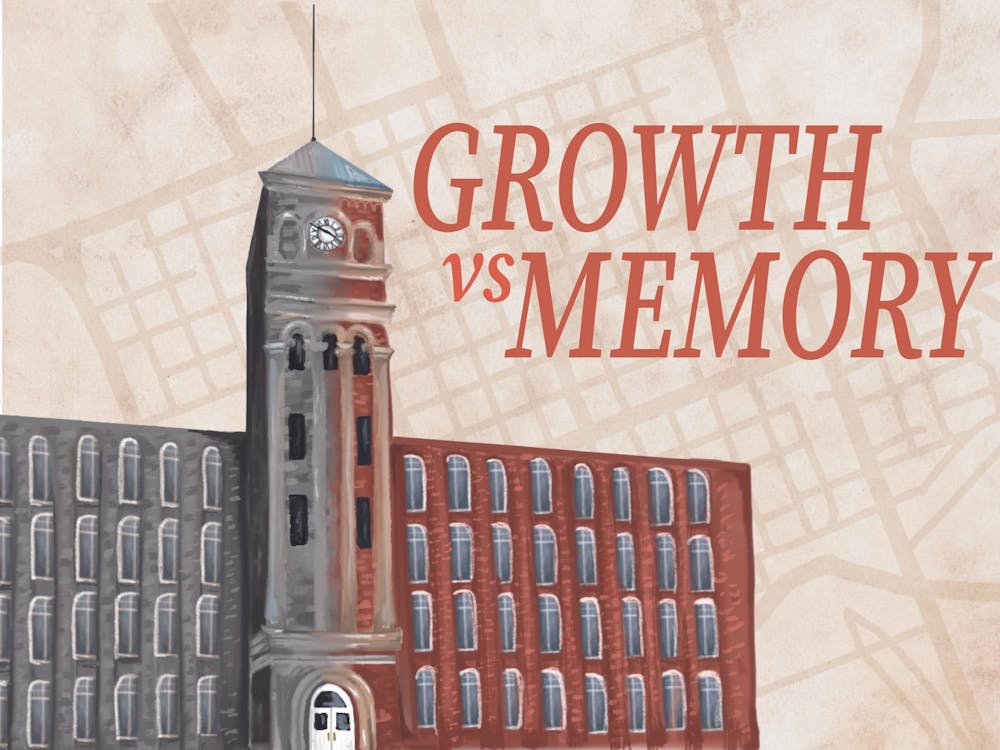
PMC Property Group owns and develops properties such as Olympia Mill and Granby Mill in Columbia, often modernizing old buildings while still attempting to maintain the historical roots. The Mills properties are large apartments that are advertised as student housing. According to PMC Property Group, these rental properties — including 612 Whaley — are aimed at housing “students and young professionals.”
However, Harry believes that Olympia and Granby Mills are two cases of college-related gentrification within the community that have aided in the destruction of historic neighborhoods at the price of university expansion.
“It was designed that way. It’s because they want people like me living here, and they don’t want people like who I was playing basketball with living here,” Harry said. “They’ll never come out and say that, but if you look at the policies, and you look at the change over time, it’s kind of evident that that’s what they’re trying to do.”
Justin Steinmann, the Director of Planning and Development Services in Columbia, says that there has been a significant amount of development of student housing in the area around the university.
Regarding requests for expansion in Granby and Olympia Mills, Steinmann says that expansion is dependent upon if the project is “permitted by right” — whether a developer is allowed to build something on a certain property without permission.
“We have two design review boards: the urban design review commission and the historic preservation design review commission,” Steinmann said. “We also have a planning commission and the board of zoning adjustment, and then a lot of things that go to those boards also ultimately have to go to city council.”
Public input is also a consideration in the approval process for new development. Steinmann says there are several boards that operate to keep the interests of Columbia residents in mind.
“All of them provide the opportunity for the public to either provide us feedback via a letter or to actually show up and express their opinions via the actual public hearing that takes place,” Steinmann said. “It’s very frequent we are in conversation with Columbia City Council regarding what they are hearing from their constituents.”
Steinmann states that he has not been made aware explicitly of any concerns from residents regarding the expansion of the university at the expense of Columbia’s historic neighborhoods. However, he admits that managing growth involves a constant awareness of the cost of growth and development.
Ultimately, Steinmann says that the city’s goal is to ensure that growth does not come at the expense of the qualities that make a neighborhood worth living in.
Bobby Donaldson is an associate professor of history at USC and the executive director of the Center for Civil Rights History and Research. Donaldson worked for the Ward One Organization in Columbia, which strives to preserve the history of the predominantly Black population that was displaced in the 1960s because of urban renewal — the redevelopment of areas in larger cities.
“What we describe as urban renewal, gentrification, institutional expansion at the expense of longtime dwellers, that is not new,” Donaldson said. “That does not excuse what happened and it does not mean that we ignore what happened.”
He has done extensive research and writings on African American history. Donaldson said the effort began “almost 20 years ago.” He describes it as a vibrant community of individuals in Columbia looking to have their history preserved.
“We were asked by former residents of the area near the [Carolina] Coliseum to assist in documenting the neighborhood’s history,” Donaldson said. “Perhaps the most important thing we did: we talked to the persons who lived in that area and began conversations and interviews.”
During his time working on the Ward One project, Donaldson explains that some Columbia residents viewed the university as an aggressor following the demolition of historic neighborhoods — marking the destruction of a historic culture.
“When you tear down our church, you tear down our school, you tear down our houses, you’re tearing down our history. There is an erasure happening.”
Donaldson states that through this erasure, Columbia is at risk of losing its history and culture that once shaped the area. Although the efforts of the Ward One project were a step at preserving this history, the modernization of Columbia — in part due to the expansion efforts of the university — is a force to be reckoned with.
“It’s impossible for any of us on campus to even fully understand that what we today acknowledge as our new campus was a community,” Donaldson said. “We were a people. We were a people with history. We were a people before the university ever even got near our sites.”
He states that areas currently in the process of new development in Columbia have been “almost blackballed, redlined,” which is not a coincidence. Blackballing is a term used to describe excluding an individual from certain opportunities or membership, which can limit people’s access to jobs or professional advancement. In contrast, redlining refers to a historically discriminatory and illegal practice where banks often withhold loans or insurance from buyers considered to be undesirable. Both blackballing and redlining have deep racial discriminatory roots, according to a report by National Geographic.
Although not single-handedly responsible for the expansion that has taken place, Donaldson urges professors and students alike at USC to consider the cost of the expansion of the university as they go about their lives.
“Wherever you see a large swath of concrete that’s a parking lot, ask a question,” Donaldson said. “What was here before?”


