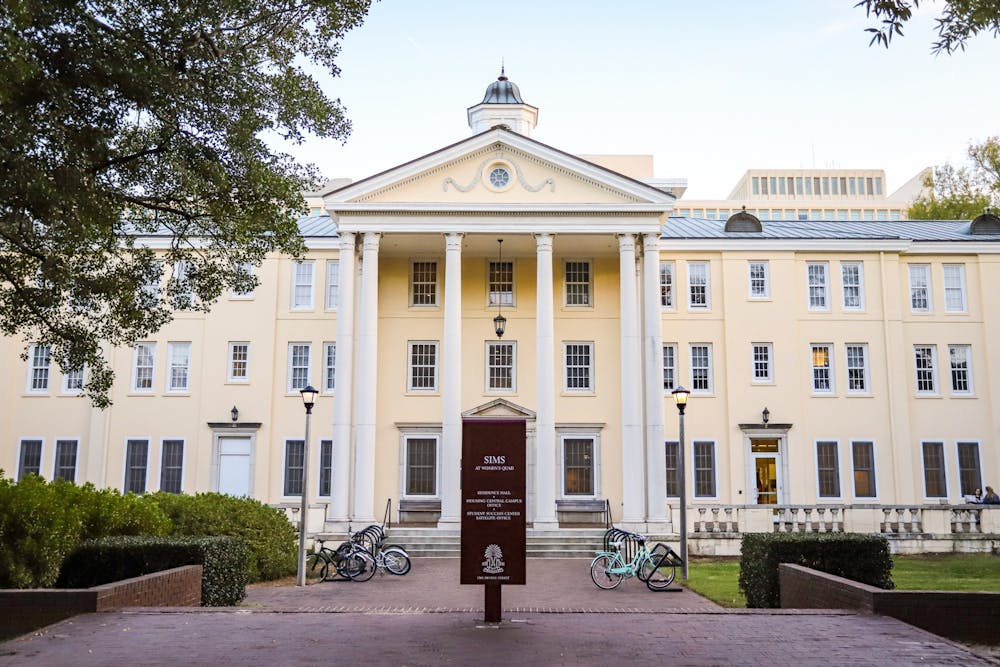
Across the USC campus, virtually every building or monument shares a name with a person of the past. From DeSaussure to Darla Moore, the landscape is filled with buildings named after wealthy donors and historical figures that few think twice about. Students hear orientation leaders tell the histories behind some names before immediately forgetting them. But what would happen if people stopped and took time to reflect on those names? What did those people accomplish that got them forever memorialized on campus?
Professor Thomas Brown, specialist on the Civil War and Reconstruction eras at USC, provided insight.
"I think the landscape kind of comes alive when you know more about it," he said. "You just get a sense when you walk around the statehouse grounds or the campus, it just has sort of a heightened clarity and vividness."
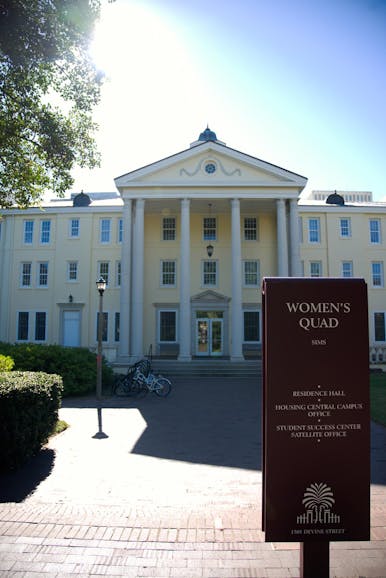
Women’s Quad is a piece of history that is hard to miss, characterized by its exterior courtyard and pillars. Located on Greene Street, hundreds of students pass the building daily. The Quad is broken into three wings – McClintock, Sims and Wade Hampton – that are referred to by either their full names or their initials on the USC signage. This small detail may seem innocuous, but there is intent behind the use of the initials. Take J. Marion Sims, for example, the namesake of "S-Quad":
James Marion Sims, a 19th-century physician, is often referred to as the “Father of Modern Gynecology” due to his development of medicine. He created the Sims speculum, a medical device still used today, and developed treatment for repairing vesicovaginal fistulas, a condition that causes extreme pain in women after childbirth, as well as many other commonly used devices and techniques.
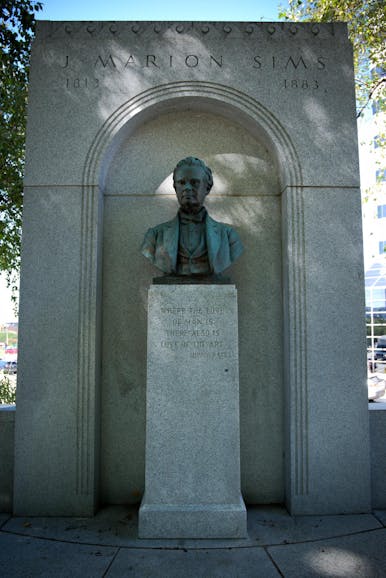
A statue of Marion J. Sims stands in downtown Columbia, South Carolina. Once celebrated as a pioneer in gynecology, Sims’ legacy has become controversial due to his unethical medical experiments on enslaved women in the 19th century.
He first gained recognition in Alabama, where he worked as a plantation physician. Eventually, this led to him operating on women with fistulas. There were many of these cases on the plantation, as the condition often resulted from women being forced to have children without consent and/or at young ages, which gave Sims the opportunity to perform a number of experimental surgeries.
These procedures were done without anesthesia, as it was a new, dangerous practice, and Sims subscribed to the belief that Black women felt less pain. There are also debates surrounding the women’s consent to the procedures, as the patients were mostly enslaved women and informed consent was not yet a widespread practice in the medical community. It was during his time in Alabama that he developed his famed repair technique and speculum.
Later, in 1855, he founded the first hospital dedicated to the treatment of female illnesses in New York. He left a lasting impact on the practice of medicine, retaining recognition throughout medical and academic communities. Whether walking on the side of the State House building past his memorial, driving down Sims Avenue or strolling along Greene Street to the Sims Quad, South Carolina bears many tributes to the late doctor.
However, despite positive ties remaining to his name and legacy, there is significant pushback against the memorialization of Sims across the country. This movement was spearheaded in 2018 by New York City when a statue of Sims was removed from Central Park. Similar motions have been advocated for in South Carolina, but most have proven unsuccessful, which comes as a surprise to many once they learn of Sims’ procedures.
Immediately after learning of Sims’ history, S-Quad resident and USC student Brookellyn Arrowood summarized her feelings towards his name with the Women’s Quad.
“I feel like that’s just putting a horrible label on this entire space,” she stated. “I feel like that should be changed.”
Her attitude is one shared by many students and citizens, yet change cannot move forward due to the Heritage Act ruling in 2021. The Heritage Act prohibits the removal, alteration or renaming of historical monuments on public land. The SC Supreme Court ruling – following a challenge of its constitutionality – upheld the law and effectively struck down efforts to change. This included an active effort to rename Sims Hall, supported by former USC President Bob Caslen.
So, as reform efforts are stalled, it is necessary to recognize where much of Sims' controversy stems from. While Sims played a significant role in technique development for the treatment of vesicovaginal fistulas, he was not the “father” of this method.
Cara Delay, a professor of Women's and Gender Studies, corroborates the argument that this knowledge was likely already known by midwives, some of the most crucial figures in reproductive healthcare at the time. Learned through experience and passed down through generations, it could not be written in a textbook due to financial, racial and gender barriers. Delay, who has done extensive research on reproductive healthcare, said this is a common phenomenon.
“What we see as historians is that what happens in the 19th Century is these doctors come in – these male, trained doctors – and they actually appropriate the knowledge that women have accumulated across generations," she said. "This experiential knowledge that, for Sims, for example, he uses – he not only experiments on the bodies of enslaved women, but he also uses enslaved women, as his so-called ‘nurses’.”
Sims also appropriated the bodily autonomy of women when performing his experiments. There are many debates over his patients’ consent to his trials and the practices of the time, but there was an inherent power imbalance between Sims – a white male doctor – and his patients, who were predominantly enslaved Black women. This means these women had no right to refuse treatment, as their treatment was decided by the plantation owner, regardless of the women's feelings about the procedures.
"I really hate that he is known as the 'father' of gynecology when those three [women] were the mothers of gynecology. I feel like their names should be mentioned most. Even though he’s the one that did it, and it really improved healthcare and reproductive care for women, it wasn’t done in a humane way whatsoever," Arrowood expressed.
The decision to memorialize Sims through the Women's Quad goes beyond his legacy. As discovered by Nicole Chandonnet in her 2021 thesis "Memorialization of J. Marion Sims in Columbia, South Carolina", the choice was one heavily rooted in the eugenics movement.
“It suggests women as sort of the beneficiaries of his solicitude and professional expertise,” stated Brown, thesis director of Chandonnet’s project. “And Sims is kind of a proto-eugenicist by helping the ‘right’ women reproduce.”
With ties to the eugenics movement, chattel slavery and the Confederacy, many consider J. Marion Sims to be far from honorable. In opposition to Sims' memorialized legacy, "The Mothers of Gynecology Monument" was unveiled in Alabama back in 2021. The statue depicts Anarcha Westcott, Lucy and Betsy – three of Sims' enslaved experimental subjects that made his work possible.
Professor Delay believes the current and future generations will continue leaving an impact on the future of Sims' memorial.
“I have such faith because I teach you all, and I'm always like, ‘If the future is in the hands of my students, I think we're going to be OK,’ because they know exactly what's going on," Delay said. "As soon as students find out about Sims, they want to do something about it."


