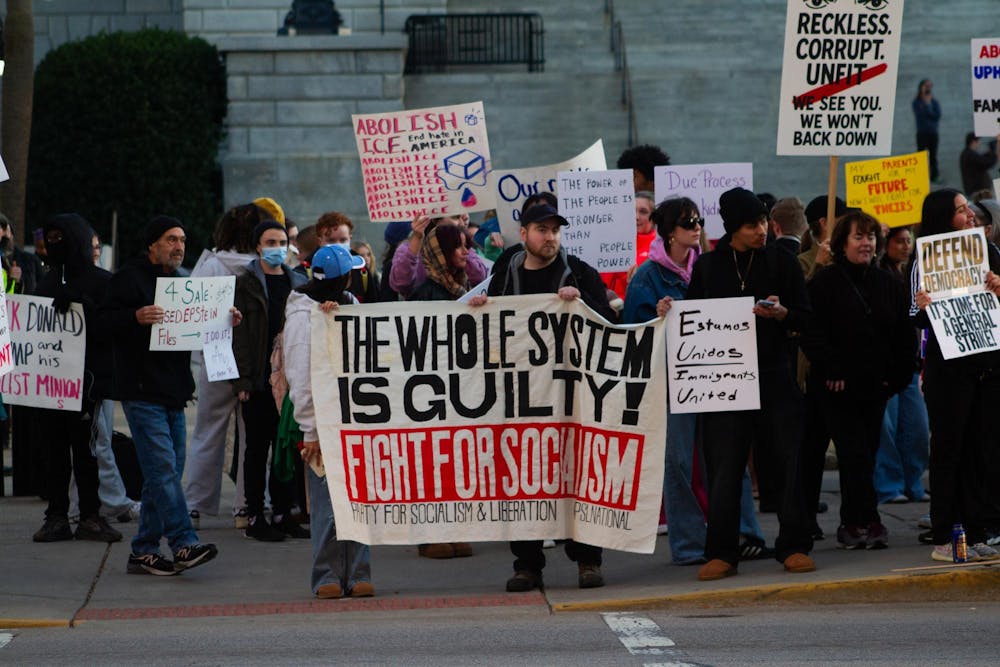
The stamping of feet on the pavement in front of the Statehouse, the blare of traffic and rumble of chanting voices calling for freedom surrounded her on all sides. Amidst the chaos of the protest, Skyler Smith had never felt more at home.
For as long as she could remember, she had felt alone. Growing up in the South, she felt isolated in her political beliefs, in her sexuality and in who she was fundamentally. She found her voice among political movements and engaging with the community in meaningful ways. As a result, she began to find her place as she got older.
When Smith, a junior at USC, heard that the Party for Socialism and Liberation (PSL) was holding a community meeting to organize a shutdown in Columbia, she knew she had to get involved. The meeting and protest were coordinated by the PSL, Midlands SC Defensa and 50501 SC.
“What really struck me at the PSL meeting was the amount of people there who were like me—from the same place as me, with accents like mine—advocating for a cause that I tend to assume my community doesn’t support,” Smith said.
Protestors gathered at the State House on Jan. 20 to show opposition to the Trump Administration and its use of U.S. Immigration and Customs Enforcement, more commonly referred to as ICE.
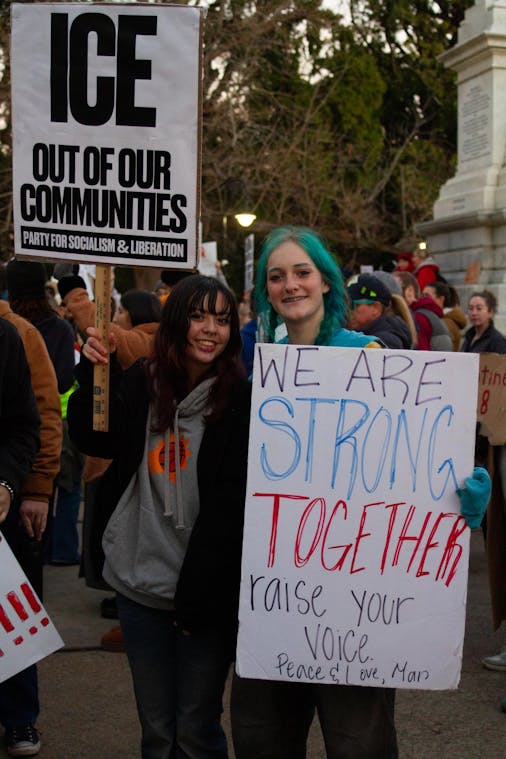
As political tensions mount and instances of violence occur all across the country, the PSL is emphasizing the importance of community organization, civil engagement and awareness of available resources in the community. Following recent political unrest in the U.S., Smith understands the instinct towards fear but believes in persevering.
“If I’m honest, what scares me more than an unsympathetic acquaintance recognizing me at a picket line is being the only person at that picket line,” Smith said.
Even as a college student, she understands the importance of mobilizing to fight for one’s beliefs in the face of opposition, fear and violence.
“We have access to information and resources that the majority of people do not have access to, and we have a duty to use our privilege for good,” Smith said of college students' responsibility to community engagement. “At the end of the day, college is four years of your life. This is going to be affecting us for decades after. So if we’re quiet now and just let it happen, we’re gonna regret a lot more than missing class in a couple of decades.”
Samantha Rainwater, a USC alumnus, is an organizer with the PSL and became involved following the 2024 presidential election. She voted socialist after feeling frustrated with the Republican and Democratic candidates. Rainwater believes that working-class people should be in charge of the economy because they are an essential mechanism in society.
“The people know that what we need to exist is food, shelter, education and healthcare," Rainwater said. "I trust myself, and I trust the people, the working people of the United States, to know that everyone deserves that."
She says that feeling disconnected from people in one’s community—especially during times of intense political polarization—is understandable but believes that people with different identities and backgrounds have more in common than they realize. She believes that the PSL is beneficial towards this goal.
“I absolutely think that the PSL and socialism in general is a way forward because it represents actual democracy, everyone getting to participate, everyone being involved in the political process," Rainwater said. "Not just during voting season, but in stuff like this, in community meetings."
Currently, the PSL is building towards a general strike to stop “business as usual” in an effort to leverage economic pressure against the immigration crackdown and further cooperation with ICE. In order to do this, she calls for people to unite around a shared goal and participate in political activism.
“We know that the most powerful actions are mass actions. And over the course of the last year, we have engaged in a lot of mass actions. We’ve made partnerships and coalitions with different groups,” Rainwater said of PSL's efforts. “We know that there is mass outrage about ICE right now.”
Rainwater and others involved with the PSL believe that protesting against ICE is crucial following racially motivated hostility towards U.S. citizens by the organization and continued detention of more than 50,000 people, about 44% of whom have no criminal record or pending charges, according to data compiled by The Guardian. Despite increased political tensions, she urges people to continue standing up for what they believe in.
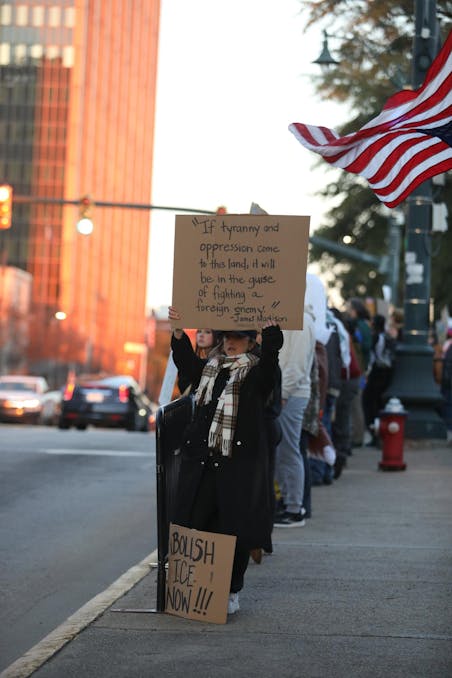
“I don’t think we should be naive about the fact that there are real dangers right now. But the way we are choosing to respond to those dangers is by visibility and numbers,” Rainwater said. “We have to stand in solidarity, or we’re all going to lose.”
In a country dominated by the two-party system and increasing partisanship, she advocates for socialism as an alternative for people who may be frustrated by the lack of options — specifically, young people who feel like their voices go unheard in the current political landscape. While socialism may seem like an abstract or extreme concept to some, she wants to focus on the people at the heart of the movement.
“The PSL is powered by the people," Rainwater said. "I believe it was Fred Hampton who said, 'if you’re afraid of socialism, you’re afraid of yourself.' The people know what they need."
The emphasis on the power of the people seems to stem from a belief in the failure of institutions who claim to serve the people of the United States but act otherwise. With this lapse in responsibility, engaging with one’s local community and taking initiative has become crucial for many.
“What is the point of the government if it is not going to take care of its people and the people know how to take care of each other,” Rainwater said.
Community member Rae Daetwyler attended the protest to speak out against ICE and the terrorization of immigrant populations. Daetwyler was gratified by the outpouring of support from the local community.
“It’s amazing. I see people I know, people I don’t know, people who I wouldn’t expect to be out here,” Daetwyler said. “I see backpacks, people came from school for this, and it’s just amazing to see people who care enough to be here.”
Hunter Johnston is a junior who also attended the protest. He participated in a more subdued kind of activism up until this point but felt called to join the protest amidst the current contentious political climate.
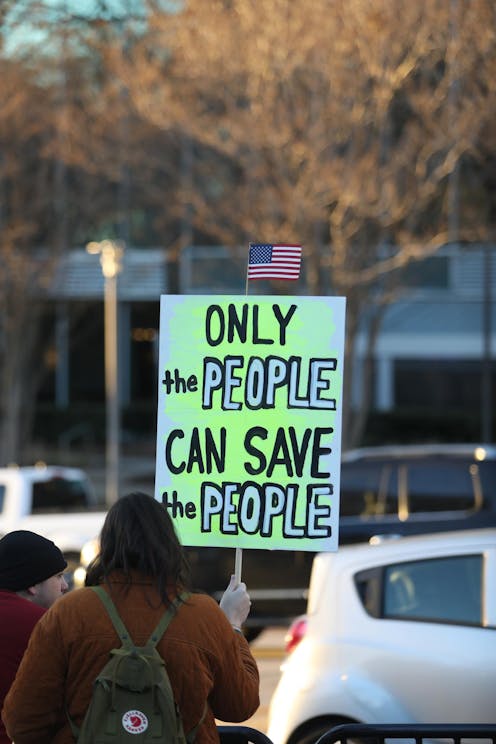
Johnston believes that the simple act of conversation is a powerful tool for beginning to break down political barriers. He advocates staying away from buzzwords in political conversations and urges everyone to “be a human being” — to act with empathy as opposed to staunch ideology. In his personal life, he tries to remain open to having difficult conversations while staying true to what he believes in politically.
“I just keep talking to people. Just keep chipping away,” Johnston said. “Your words are powerful even if you don't think they are.”
Smith understands that a single protest may not change the minds of those in power overnight, but she believes in the importance of using one’s voice to stand up for what they believe in and show solidarity within their community.
“For me, it’s more that if there are people out there who are afraid right now or they’re afraid that they’re alone, you’re not. And this is for you,” Smith said. “It’s not for the people in power. It’s for you to know that you’re not alone.”


